
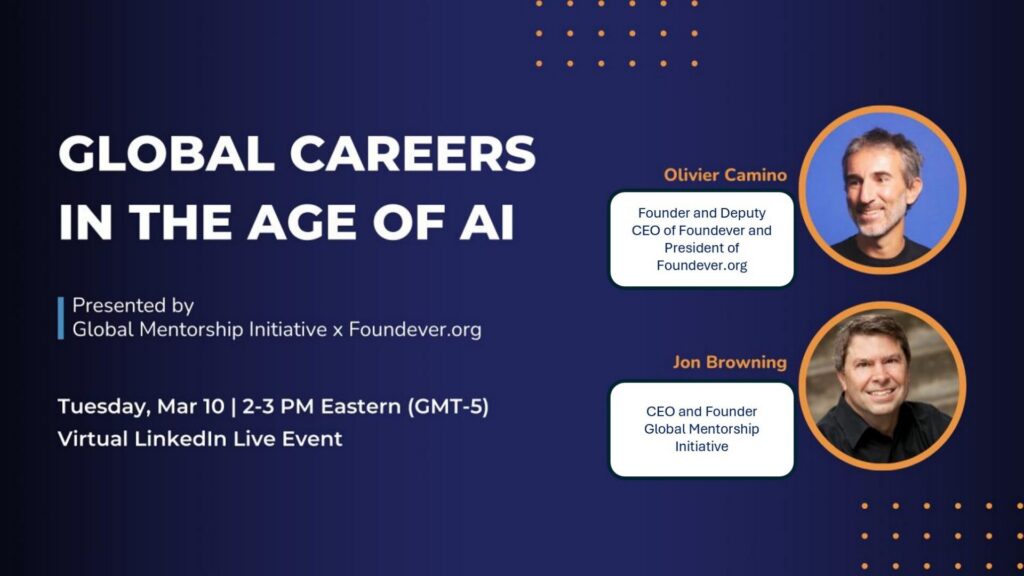
Artificial intelligence is not only changing how we work, it is redefining how careers begin, evolve, and grow. For young professionals entering the workforce today, the challenge is no longer simply choosing a profession. It is learning how to navigate a world where technologies evolve rapidly, industries transform continuously, and career paths are increasingly fluid. In this environment, access to guidance, skills, and opportunity becomes critical.
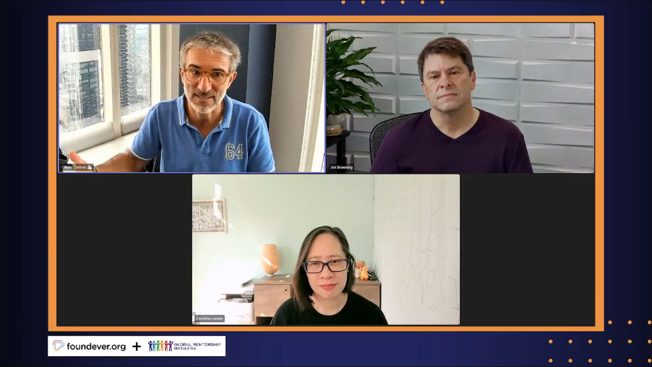
These questions were explored in a recent LinkedIn Live conversation hosted by the Global Mentorship Initiative (GMI), bringing together Jon Browning, Founder and CEO of GMI, and Olivier Camino, President of Foundever.org and Founder and Deputy CEO of Foundever, to discuss the future of work, the impact of AI, and the role mentorship can play in expanding opportunity globally.
One idea emerging from the discussion captures a broader shift taking place across many industries.
“In many ways, companies today are educators”, Olivier Camino
This observation reflects a practical reality of the modern workforce. Many professionals enter organizations without a perfectly defined career path. In fast-evolving industries, individuals often discover their direction through experience, training, and exposure to new technologies and environments.
Customer experience and digital service sectors illustrate this particularly well. These industries bring together people from diverse cultural, educational, and professional backgrounds. For many, these roles represent a first step into the global economy. Inside these environments, learning does not stop after onboarding. Continuous training, mentorship, and professional development become integral parts of the professional journey.
In that sense, organizations are not only employers. They are ecosystems where people develop capabilities, confidence, and professional direction.
This role becomes even more significant as artificial intelligence reshapes the workplace.
AI is increasingly capable of handling repetitive tasks, processing large volumes of data, and supporting operational efficiency. But the growing presence of intelligent technologies does not reduce the importance of human talent. In many cases, it does the opposite.
When automation removes routine tasks, human skills become more visible and more valuable. Empathy, contextual understanding, creativity, and complex problem-solving remain fundamentally human capabilities. AI can enhance productivity, but human judgment remains central to meaningful interactions and decision-making.
“AI can take away repetitive tasks and distractions so people can focus on what really matters: understanding people, solving problems, and building meaningful connections”, Olivier Camino
However, technology adoption is rarely only a technical challenge. It is also a human one. Successful transformation depends on helping people understand how technologies support their work and how they can use them effectively. Training and cultural adoption therefore become as important as the tools themselves.
For professionals starting their careers today, this environment requires a different mindset. The traditional model of a single, predictable career path is gradually being replaced by more dynamic trajectories. Many individuals will move across several roles, industries, or skill areas during their professional lives. Continuous learning therefore becomes essential.
Technical expertise remains important, but it must increasingly be complemented by broader human capabilities: collaboration, communication, creativity, and adaptability. These qualities enable professionals to navigate uncertainty and contribute meaningfully in complex environments.
The globalization of work further amplifies this shift. Teams today often span multiple countries, cultures, and perspectives. Working effectively in such contexts requires cultural awareness and openness to different ways of thinking and collaborating.
These capabilities are rarely developed through theory alone. They grow through exposure, experience, and interaction. Mentorship plays a critical role in making that possible.
Through mentorship, experienced professionals can share insights that help young professionals understand how professional environments work — from navigating recruitment processes to developing career narratives and identifying opportunities aligned with their ambitions.
“Mentorship creates opportunity not only for those being mentored, but also for those who mentor. Both sides grow through the experience”, Olivier Camino
Programs that connect students and professionals across borders demonstrate the power of these relationships. Mentorship helps individuals build confidence, expand networks, and better understand how to position themselves in an evolving global labor market.
At a time when technology is advancing faster than ever, one idea becomes increasingly clear: opportunity grows when people choose to invest in other people.
Through initiatives focused on mentorship, education, and digital skills development, Foundever.org seeks to expand access to the capabilities needed for the future of work, connecting employees, communities, and partners around the world. It is also the principle behind the broader #CXForGood movement, using the power of people, skills, and technology to expand opportunity and create meaningful impact.